

🌟 Transform Your Kitchen: Replace Fluorescent Under-Cabinet Lights with LED (Easy DIY!)
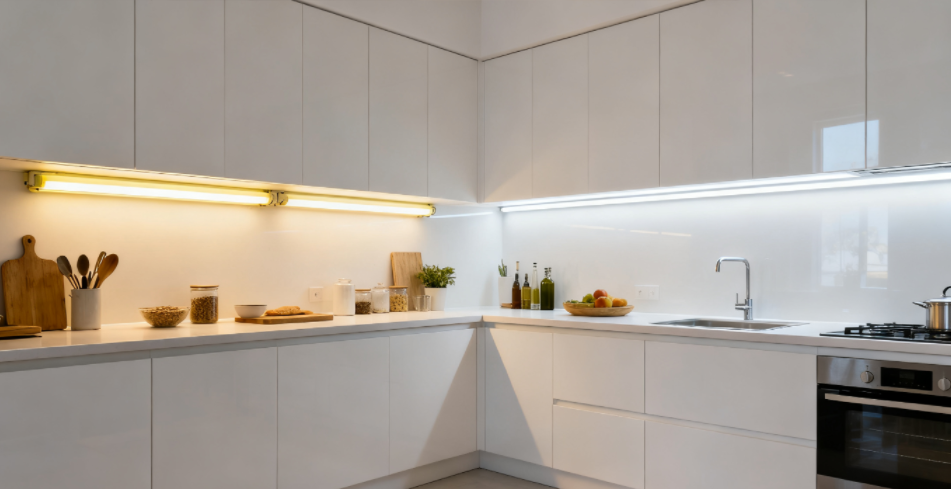
Tired of flickering, buzzing fluorescent lights under your kitchen cabinets? You’re not alone. Millions of homeowners are ditching outdated fluorescent fixtures for sleek, energy-efficient LED under-cabinet lighting—and for good reason. Not only do LEDs last up to 25 times longer, but they also cut energy bills, eliminate the need for ballasts, and provide brighter, more natural light.
In this comprehensive step-by-step guide, we’ll walk you through how to safely and affordably replace your fluorescent under-cabinet lights with LED tubes—even if you’ve never touched a wire before. Based on a real-world DIY project (with full safety reminders!), this tutorial empowers you to upgrade your kitchen lighting in under an hour.
💡 Pro Tip: This retrofit works for most standard under-cabinet fluorescent fixtures—no rewiring or new fixtures required!
🛠️ Why Replace Fluorescent Lights with LED?
Before we dive into the how-to, let’s talk why this upgrade is worth your time:
Energy Savings: LEDs use up to 60% less energy than fluorescents.
Longer Lifespan: Fluorescent tubes last ~10,000 hours; LEDs last 25,000–50,000+ hours.
No More Ballast Failures: Ballasts hum, buzz, and fail—LEDs bypass them entirely.
Better Light Quality: LEDs offer crisp, shadow-free illumination perfect for food prep.
Eco-Friendly: No mercury (unlike fluorescents), lower carbon footprint.
⚠️ Note: The original video creator mentions a failed ballast as the catalyst—this is a common sign it’s time to upgrade!
🔌 Tools & Materials You’ll Need
You don’t need a pro toolkit. Here’s what to gather:
LED T8 or T12 tubes (double-ended powered—more on this below)
Screwdriver (Phillips or flathead, depending on fixture)
Wire strippers
Needle-nose pliers
Wire nuts (red or yellow recommended)
Electrical tape (optional, for extra safety)
Voltage tester (highly recommended!)
Ladder or step stool
📌 Critical: Turn off power at the circuit breaker before starting—even if the video didn’t! Safety first.
🔍 Step 1: Choose the Right LED Tubes
Not all LED tubes are created equal. For a direct fluorescent replacement, you need:
✅ Double-ended powered (Type B) LED tubes
These connect to line voltage (120V) directly—no ballast needed.
One end connects to hot (black), the other to neutral (white).
❌ Avoid:
Single-ended (Type A) tubes—they require a working ballast (defeating the purpose).
Hybrid tubes (Type AB)—confusing and unnecessary for this retrofit.
📝 Pro Tip: Look for labels like “Ballast Bypass” or “Direct Wire” on the packaging. Popular brands include Philips, GE, and Hyperikon.
🔧 Step 2: Turn Off Power & Remove the Old Fixture
Safety First!
Flip the circuit breaker that controls your under-cabinet lights.
Test with a non-contact voltage tester to confirm power is off.
Remove the fluorescent tubes (wear gloves—they contain mercury!).
Remove the Fixture Housing
Most under-cabinet fixtures are held by 2–4 screws on the sides or bottom.
Gently pull the fixture down to expose the wiring compartment.
You’ll see the ballast (a heavy metal box) and a tangle of wires—don’t panic!
📌 Note: The video shows the creator removing screws from the ballast itself to free the housing—this is optional but can make access easier.
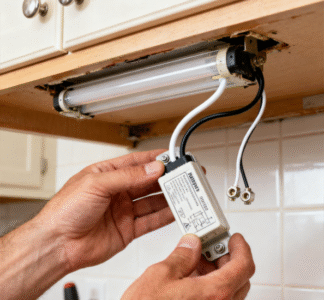
“Close-up of hands removing an old fluorescent under-cabinet light fixture from kitchen cabinets. Visible ballast, white and black wires, and wire nuts. Clean, well-lit workshop-style photo.”
⚡ Step 3: Remove the Ballast & Prep Wires
This is the heart of the retrofit: bypassing the ballast entirely.
Disconnect all wires from the ballast.
Typically: 2 input wires (from power source) + 2–4 output wires (to lamp holders).
Cut the wires as close to the ballast as possible.
Save the longest possible lengths from the lamp holders—you’ll reuse them!
Remove the ballast from the fixture housing.
This reduces weight and eliminates future failure points.
💡 Why remove the ballast? It’s obsolete with direct-wire LEDs—and it wastes energy even when “off.”
Now your fixture should look clean, with just two sets of wires coming from the lamp holders (one set per end of the tube).
🔌 Step 4: Rewire for Direct LED Connection
Here’s where many DIYers get confused—but it’s simpler than it looks.
Identify Your Wires
Incoming power: Usually one black (hot) and one white (neutral) wire from your wall.
Outgoing power: If you have multiple fixtures daisy-chained, there may be a second set feeding the next light.
Lamp holder wires: Typically 2 wires per end (colors vary—often blue, red, or black/white).
📌 Key Insight: Color doesn’t matter as much as function. You’re creating two groups:
All hot-side lamp wires → connect to incoming black (hot)
All neutral-side lamp wires → connect to incoming white (neutral)
Create Your Connections
Group all neutral-side lamp wires + incoming white wire + outgoing white (if present).
Twist together securely and cap with a wire nut.
Repeat for hot-side wires (black + lamp hot wires + outgoing black).
Tug test: Ensure no wires pull loose.
(Optional) Wrap connections with electrical tape for added security.
⚠️ Warning: Never work on live wires! The video creator admits this was risky—always shut off power.
“Diagram-style illustration showing wiring for LED under-cabinet retrofit: incoming black/white wires connected to grouped lamp holder wires, with ballast removed. Clean, labeled, technical drawing on white background.”
💡 Step 5: Install LED Tubes & Reassemble
Insert your new LED tubes into the lamp holders.
They only go in one way—align the pins with the slots.
Push the fixture housing back into place under the cabinet.
Most have small metal tabs that snap into grooves.
Restore power at the breaker.
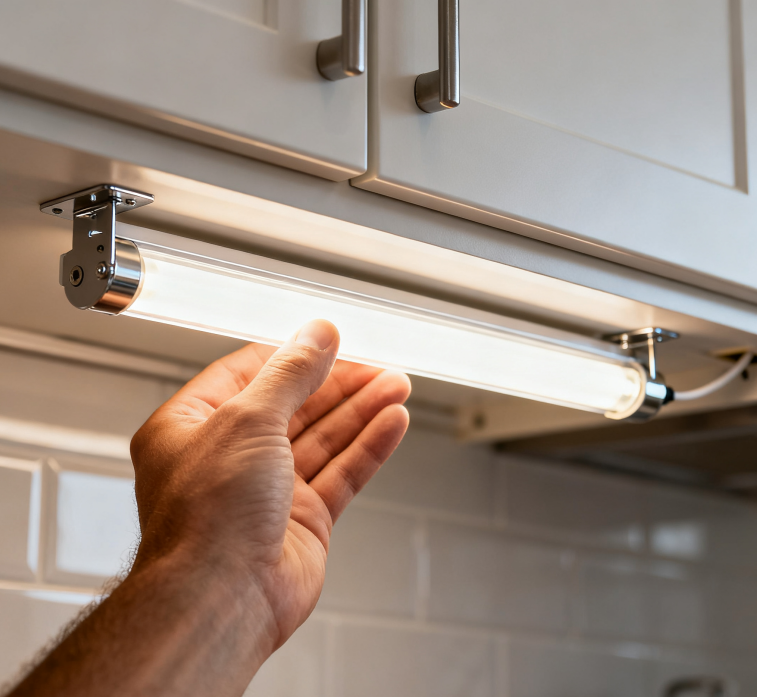
Flip the switch—enjoy your bright, flicker-free LED light!
✅ Success Check:
Light turns on instantly (no warm-up!)
No buzzing or flickering
Fixture feels cool to the touch
🔒 Safety Reminders (Non-Negotiable!)
While the video demonstrates the process clearly, it skips a critical step: turning off the power. Don’t follow that part!
✅ Always:
Shut off the correct circuit breaker
Verify with a voltage tester
Use insulated tools
Work with a buddy if possible
❌ Never:
Assume the switch turns off all power (it often doesn’t!)
Touch bare wires without confirming de-energization
Reuse old, brittle wire nuts
🛡️ Peace of Mind: If you’re uncomfortable with wiring, hire a licensed electrician. But for most, this is a safe, beginner-friendly project.
💰 Cost & Energy Savings Breakdown
Energy Use
~60W per fixture
~24W per fixture
Electricity Cost*
$7.00
$2.80
Bulb Replacement
Every 1–2 years
Every 10–15 years
5-Year Savings
—
$25+ per fixture
*Based on 3 hrs/day, $0.13/kWh
📈 Bonus: Many utility companies offer LED rebates—check before you buy!
❓ FAQs: Your Top Questions Answered
Q: Can I use the same fixture housing?
A: Yes! You’re only replacing tubes and rewiring—no need for new mounts.
Q: What if my fixture has only one lamp holder?
A: Same process—just connect both ends of the LED tube to hot and neutral.
Q: Do I need special LED tubes for kitchens?
A: Not necessarily, but choose high CRI (>90) for true color rendering (great for cooking!).
Q: Can I dim these LEDs?
A: Only if you buy dimmable LED tubes AND have a compatible dimmer switch (most under-cabinet circuits aren’t dimmed).
🌈 Final Thoughts: Brighten Your Kitchen the Smart Way
Upgrading from fluorescent to LED under-cabinet lighting is one of the highest-ROI home improvements you can make. It’s affordable, eco-friendly, and dramatically improves your kitchen’s functionality and ambiance.
With this guide, you’ve got everything you need to tackle the project safely and confidently—no electrician required. Just remember: turn off the power, double-check your connections, and enjoy the glow of modern, efficient lighting.
🙌 Ready to upgrade? Share your before-and-after photos in the comments—we’d love to see your transformation!